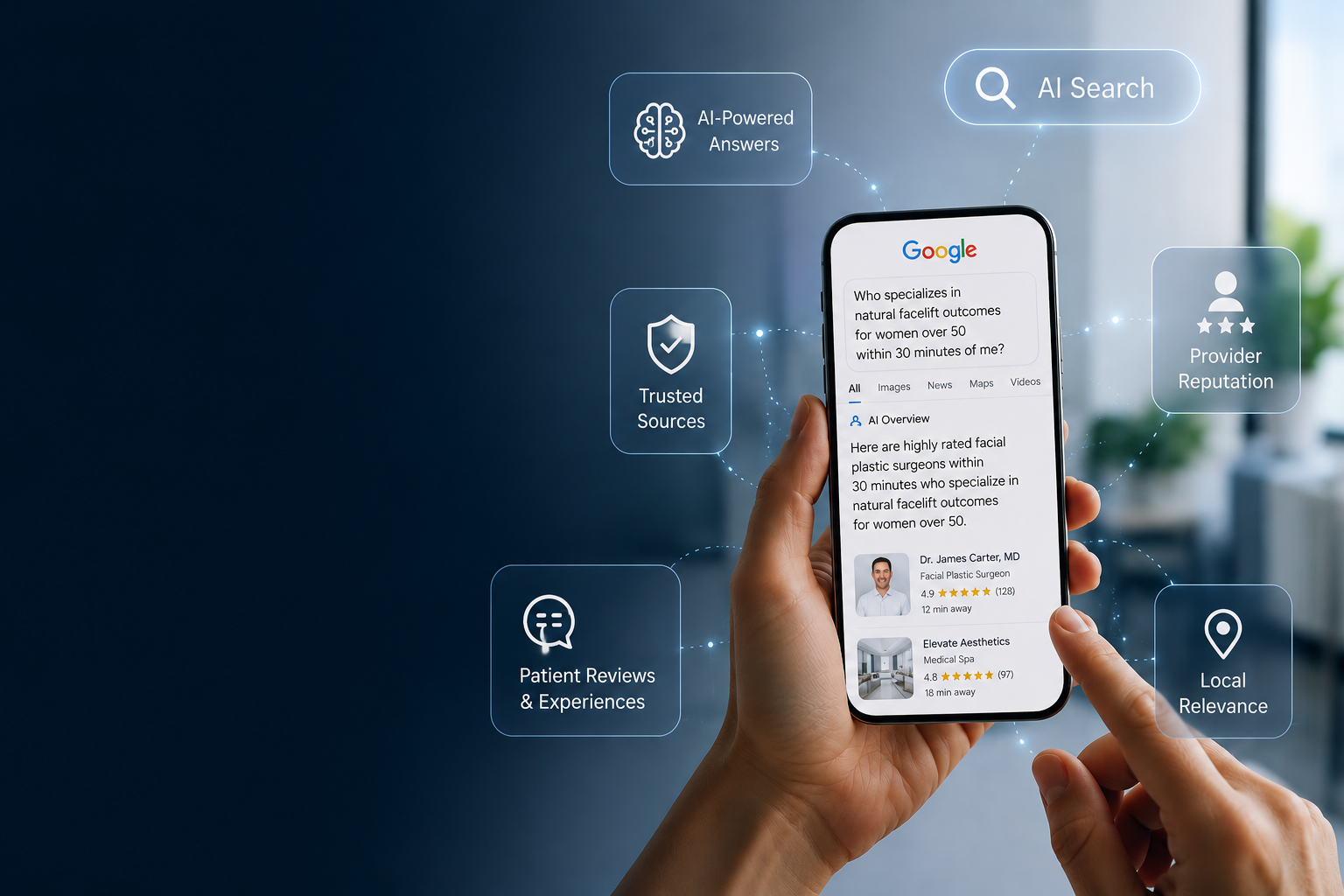
AI-powered search is changing how prospective patients discover and evaluate providers. Here is why healthcare organizations should pay attention.
Google recently announced one of the most significant changes to Search in more than 25 years, introducing deeper AI integration designed to deliver more conversational, personalized, and synthesized answers. For healthcare organizations, particularly those operating in elective specialties such as plastic surgery and medical aesthetics, this raises an important question:
How will AI change the way prospective patients discover and evaluate providers?
Increasingly, the question healthcare leaders should be asking is no longer simply:
“How do we rank higher?”
Instead, it may become:
“How do we ensure our practice is recognized as the most credible answer?”
That distinction matters because, as AI reshapes search, practices competing on authority, reputation, and expertise may outperform those competing solely on keywords.
Search Is Evolving From Finding Information to Receiving Answers
Historically, healthcare marketing strategies focused on improving visibility through:
- SEO
- Paid advertising
- Local search optimization
- Reviews and reputation management
- Educational content
Those tactics remain important. However, AI-powered search is shifting the experience from finding websites to receiving synthesized recommendations and direct answers. Users are increasingly asking longer, more nuanced questions and expecting personalized responses rather than lists of links.
Instead of searching:
“Best facelift surgeon near me”
Consumers may ask:
“Who specializes in natural facelift outcomes for women over 50 within 30 minutes of me?”
Or:
“Which med spas are known for strong patient reviews and natural injectable results?”
AI systems are increasingly designed to aggregate information across websites, reviews, educational content, and broader digital footprints to generate recommendations. The implication for healthcare organizations is significant: Visibility may increasingly depend on whether AI understands, trusts, and references your practice.
Why This Matters for Plastic Surgery and Medical Aesthetic Practices
Elective healthcare has always been built on trust. Patients often spend weeks, and in many cases months, researching procedures, providers, reviews, before-and-after galleries, and expected outcomes before making decisions. AI-powered search could compress portions of that journey by helping consumers synthesize information more efficiently.
Practices with strong authority signals, differentiated positioning, robust online reputations, and consistent educational content may benefit disproportionately. Conversely, practices relying primarily on traditional SEO tactics without broader brand authority could face increasing challenges as search behavior evolves.
This does not mean SEO is disappearing. But SEO alone may no longer be enough.
Three Areas Healthcare Organizations Should Prioritize
1. Build authority, not just rankings
Historically, ranking highly for a target keyword was often considered the objective. As AI-driven search evolves, ranking #1 may become less meaningful if AI-generated responses surface recommendations before users engage with traditional search results. Healthcare organizations should focus on strengthening:
- Educational content
- Demonstrated physician expertise
- Thought leadership
- Patient reviews and reputation management
- Third-party mentions and credibility signals
- Consistency across digital channels
Practices recognized as trusted authorities may hold a meaningful advantage in an increasingly AI-driven environment.
2. Expand measurement beyond traditional marketing metrics
Clicks, impressions, and website traffic have long served as proxy metrics. They may indicate activity, but they do not necessarily measure business outcomes. Healthcare organizations should increasingly seek visibility into:
- Patient acquisition by channel
- Revenue attribution
- Brand mentions across AI platforms
- AI visibility and citation frequency
- Changes in referral patterns as search evolves
Organizations that begin measuring these shifts early may be better positioned to identify opportunities before competitors do.
3. Diversify digital presence
Future visibility may depend less on performance within a single platform and more on overall digital authority.
That includes strengthening presence across:
- Search engines
- AI platforms
- Review ecosystems
- Social media
- Video content
- Industry publications and earned media
Consumers do not discover providers through one channel.
Increasingly, AI may synthesize information from many.
The Bigger Strategic Question
The future of healthcare marketing may not be defined by who ranks highest. It may be defined by who is recognized as the most trusted source. That represents a meaningful shift in how healthcare organizations should think about growth, visibility, and patient acquisition. Healthcare leaders should begin evaluating whether their current marketing strategies are designed for where patient behavior is headed, not simply where it has been. Questions worth asking include:
- Is our organization positioned as an authority within our specialty?
- Are we measuring the right indicators beyond traffic and impressions?
- How visible is our brand within emerging AI-driven search experiences?
- Does our digital strategy support long-term patient acquisition as search behavior changes?
At Skytale, our marketing advisory team helps healthcare organizations answer these questions through comprehensive marketing evaluations and ongoing Fractional CMO support. We work with practices to assess current performance, identify growth opportunities, strengthen visibility, and align marketing investments with measurable business outcomes.
As AI continues reshaping how consumers discover information online, healthcare organizations may need to rethink not only how they market, but how they establish authority and trust in an increasingly AI-driven environment. For organizations evaluating whether their current marketing strategy is positioned for this shift, the key question may no longer be whether patients can find your practice, but whether emerging search experiences recognize your organization as a trusted source worth surfacing.
To learn more about how Skytale supports healthcare organizations through strategic marketing advisory and Fractional CMO services.
AI search is not simply a technology update.
For healthcare marketing, it may represent one of the next major shifts in how patients discover, evaluate, and ultimately choose providers.
The organizations preparing today may be better positioned to lead tomorrow.